Battery reports for Tesla vehicles
Know the real health of a Tesla battery.
For Tesla Model S, 3, X and Y. Plug in an OBD adapter, tap Analyze, and EV Vitals reads the high-voltage battery data the car broadcasts — then hands you a clear, shop-branded Battery Health Report and Used Vehicle Report for your customer.
What it does
Everything you need for a Tesla battery inspection
Built for EV shops, inspectors and used-Tesla buyers. Plain-language results anyone can understand, backed by the numbers a technician needs.
Battery health & grade
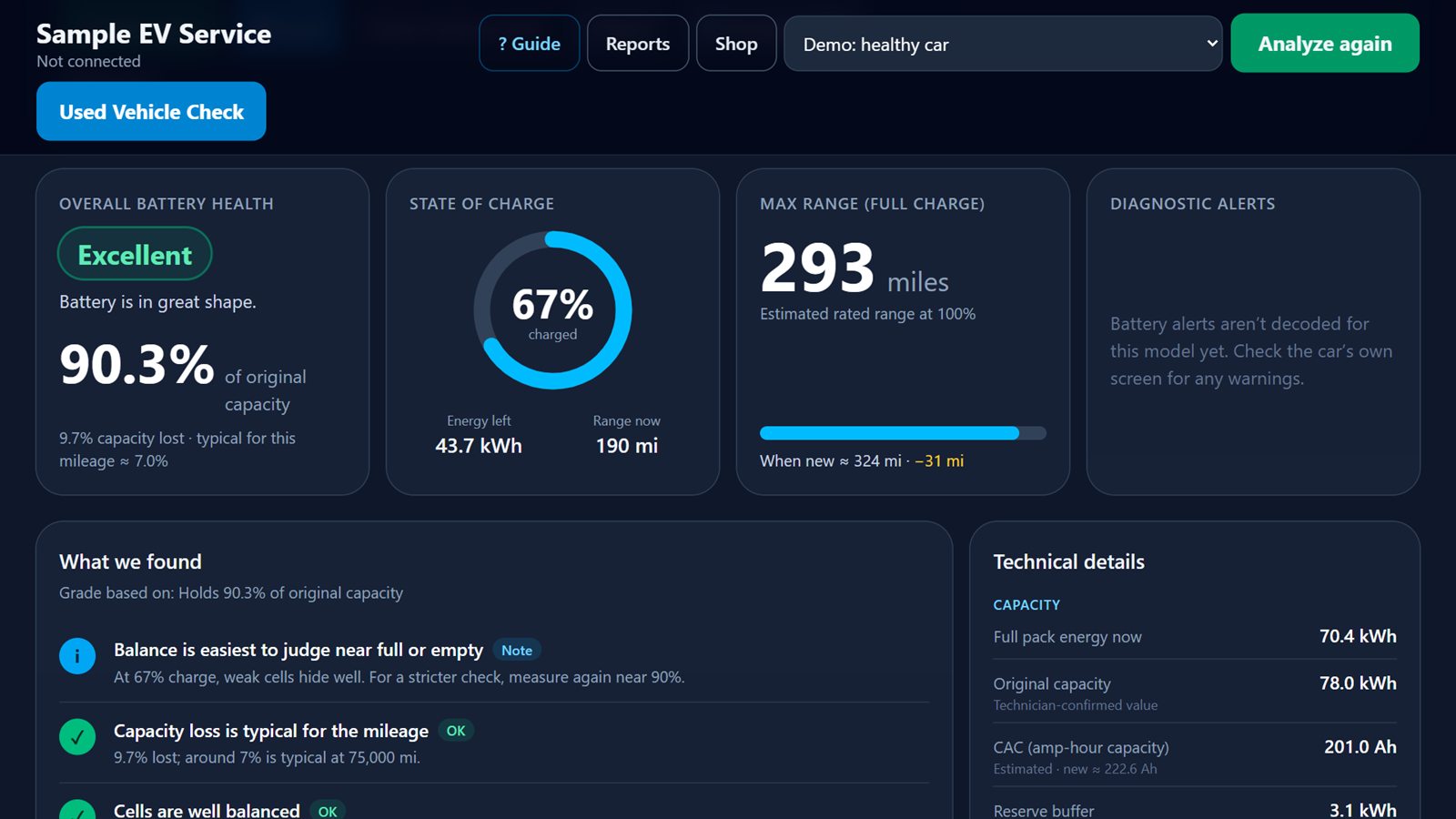
Estimated state of health against the pack's original capacity, usable energy, estimated range and an overall grade — compared with what's typical for the car's age and mileage.*
Cell balance & cell map
Every cell group's voltage on one map. Weak or out-of-balance groups stand out immediately, with temperatures across the pack.
Load test
An optional rest-versus-load test estimates resistance per cell group, helping spot high-resistance cells a resting check can miss.*
Used Vehicle Check
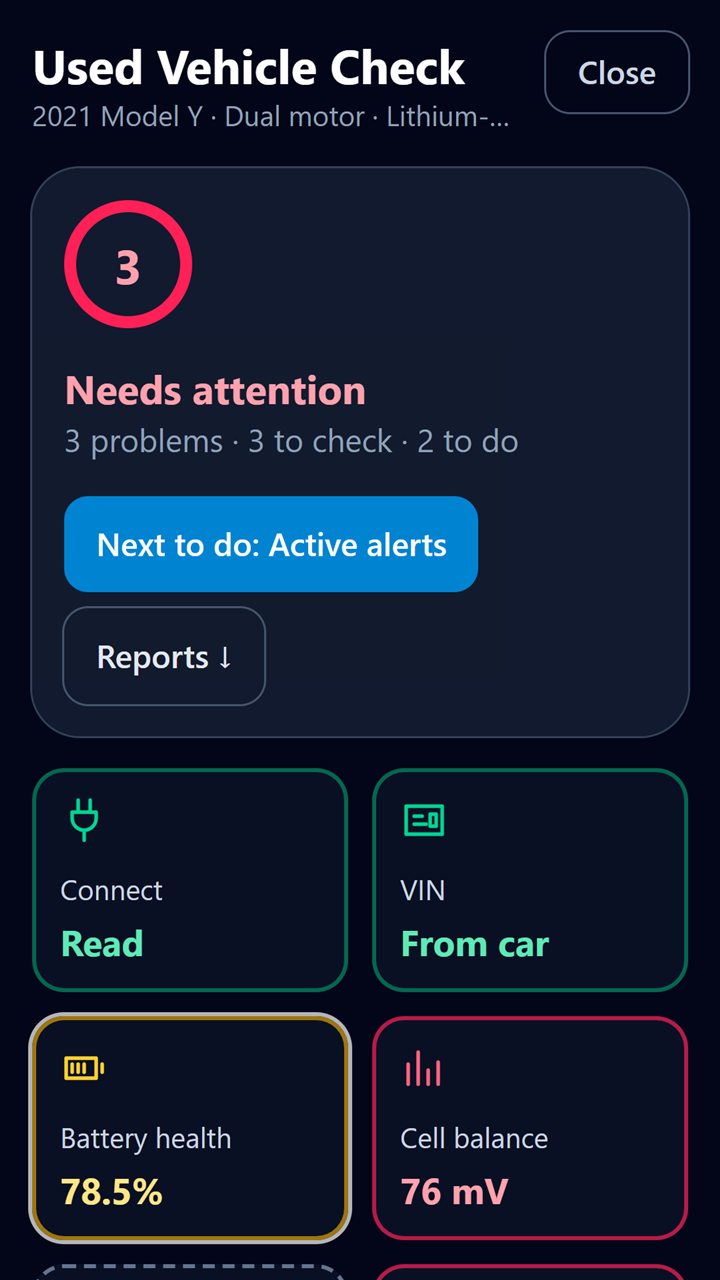
A pre-purchase scorecard for a used Tesla: VIN match, battery, balance, alerts, cooling, mileage consistency, charging history and service records — with a separate Used Vehicle Report.*
Branded PDF reports
Your shop name and logo on a professional report. View it in the app, print it, share it or email it to the customer in one tap.
Safe by design
EV Vitals only listens to the data the car already broadcasts. It never sends commands, never clears codes and never changes settings.
Screenshots
See it in action
Screenshots use the app's built-in demo vehicles; shop and customer names are samples.
Platforms
Use the device you already have
Android phones & tablets
Android 8 or newer. Connects to classic Bluetooth and Bluetooth LE adapters.
Coming soon to Google PlayiPhone & iPad
Works with the OBDLink MX+, vLinker FS and Bluetooth LE adapters.
Coming soon to the App StoreWindows laptops
Runs in Chrome or Edge — no install. Connects over a Bluetooth COM port, USB or Bluetooth LE.
Coming soonVehicles
Supported cars
EV Vitals currently supports Tesla vehicles. More makes are planned.
| Model | Status | Notes |
|---|---|---|
| Model 3 | Supported | Verified on a 2022 Long Range. |
| Model S | Supported | 2012–2020, verified on a 2016 P90D. Nosecone and facelift 2016 cars need different cables. |
| Model Y | Expected | Shares the Model 3 battery data; not yet verified on a car. |
| Model X | Expected | 2016–2020 shares the Model S data; not yet verified on a car. |
Hardware
What you need
- A Bluetooth OBD adapter. Recommended: OBDLink MX+ or vLinker FS. Bluetooth LE adapters such as the OBDLink CX also work.
- A Tesla diagnostic cable. Teslas need a harness to reach the battery data — we recommend a 3-in-1 cable that covers Model S, 3, X and Y. The in-app Quick start shows where it plugs in.
- The car awake and in Park. Open a door or turn on climate so the battery system is broadcasting.
Hardware
Get the adapter and cable
You need one Bluetooth OBD adapter and the diagnostic cable that matches your Tesla's model and year.
OBDLink MX+
Recommended — premium pick. Fast, reliable, and works with Android, iPhone, iPad and Windows.
View on AmazonvLinker FS (Bluetooth)
Recommended — great value. Works with Android, iPhone/iPad and Windows.
View on AmazonOBDLink CX (Bluetooth LE)
Compact Bluetooth LE adapter — no pairing needed. Also works in Chrome or Edge on a laptop.
Search on AmazonDiagnostic cable
Teslas don't have a standard OBD port where the battery data is, so you need a Tesla diagnostic cable.
3-in-1 Tesla diagnostic cable (12 / 20 / 26-pin)
Our recommended cable: one kit for Model S, 3, X and Y. The 26-pin plug fits Model 3/Y; the 12-pin and 20-pin plugs fit Model S/X.
View on AmazonWhere does it plug in?
The app's Quick start shows the connector location for each model, with links to Tesla's service manual. 2016 Model S cars with the facelift front can need a refresh-specific cable — check the listing covers your car.
Other Tesla cablesAs an Amazon Associate, EV Vitals earns from qualifying purchases. Check that a cable lists your exact model and year before buying.
FAQ
Questions
Is EV Vitals made or approved by Tesla?
No. EV Vitals is an independent app by eShield Systems. It is not affiliated with, endorsed by or sponsored by Tesla, Inc. "Tesla" and the model names are used only to describe which vehicles the app works with.
How accurate is the battery health figure?
State of health is calculated by comparing the energy the battery management system reports with the pack's original capacity. It's a good indicator, but it is an estimate: it can differ from Tesla service tools or a full capacity test, and depends on the battery having settled and the correct pack being selected. See how the numbers are worked out.
Is it safe to use on a customer's car?
Yes. EV Vitals is listen-only: it reads the data the car already broadcasts and refuses to send anything that could change the vehicle. It never clears codes, resets anything or writes settings.
How long does an inspection take?
A battery analysis usually takes 10–20 seconds once the adapter is connected. The full Used Vehicle Check, including the technician's checks, takes a few minutes.
Do I need an account or internet connection?
No. There's no sign-up, and inspections run entirely on your device. You only need a connection to email or share a report.
Where are my reports stored?
On your device only. Saved inspections and your shop details never leave the device unless you share or email a report yourself. See the privacy policy.
Which adapter should I buy?
The OBDLink MX+ and vLinker FS work on Android, iPhone, iPad and Windows. You'll also need the diagnostic cable for your car's model and year.
Can it read fault codes?
EV Vitals reports battery-related alerts the car broadcasts where they can be decoded, and the Used Vehicle Check records anything shown on the car's screen. It doesn't request or clear diagnostic trouble codes, because that would mean sending commands to the car.
How the numbers are worked out
Measured, calculated and estimated
EV Vitals is not a Tesla diagnostic tool. It listens to data the car broadcasts and works out the rest. Here's which figures are which, so you can read a report with that in mind.
Read directly from the car
- Cell-group voltages and pack voltage
- Pack current and temperatures
- State of charge, and the energy figures the battery management system reports
- VIN, odometer, and lifetime charge/discharge energy where the car sends them
Calculated or estimated by EV Vitals
- State of health — reported full-pack energy compared with the pack's original capacity, which comes from published specifications or the likely pack for the model and year
- Range — usable energy divided by a typical consumption figure; real-world range varies
- Grade and "typical for its age" — compared with general degradation trends, not data about this car's history
- Load test resistance — estimated from voltage change under a modest load
- Charging history, cycles and mileage consistency — derived from lifetime energy counters and the odometer
- Likely battery pack and model name — inferred from the VIN and energy readings when not entered
Estimates depend on the car broadcasting accurate data, the battery having settled, and the vehicle details being correct. Results can differ from Tesla service tools, the car's own display, or a full battery capacity test. EV Vitals reports are for information, to support an inspection by a qualified person; they are not a warranty, certification or guarantee of the battery's condition, life or value.
Get EV Vitals
One purchase, no subscription. Available soon on the App Store and Google Play.